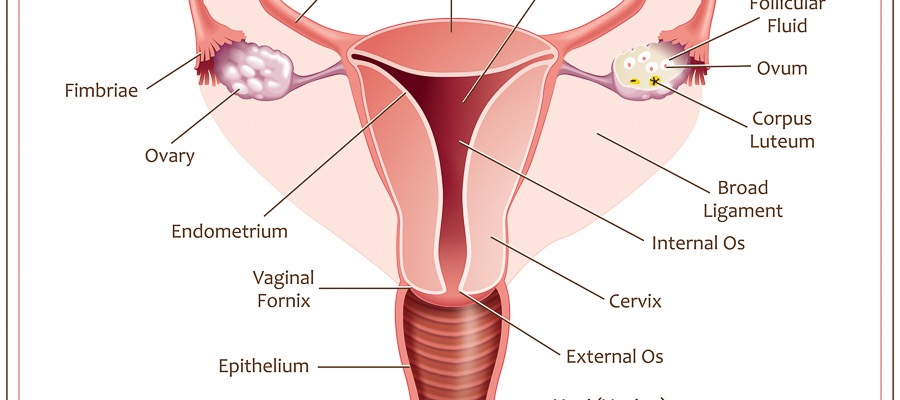
The female reproductive system consists of the ovaries, uterus, fallopian tubes, vagina, and vulva. The two ovaries contain thousands of eggs, and once a month during a female's fertile years, an egg is released into the fallopian tube by one of the two ovaries. If the egg is fertilized, it implants on the wall of the uterus. The system is designed to conduct several functions: it produces the female egg cells necessary for reproduction, called the ova or oocytes; it transports the ova to the site of fertilization; and it supports conception — fertilization of an egg by a sperm — which normally occurs in the fallopian tubes. The next step for the fertilized egg is to implant into the walls of the uterus, beginning the initial stages of pregnancy. If fertilization and/or implantation does not take place, the system is designed to menstruate — the monthly shedding of the uterine lining. In addition, the female reproductive system produces female sex hormones that maintain the reproductive cycle.
In the book I Am a Beautiful Flower: What Every Flowering Girl Should Know, there is a chapter called "Reproductive System Vocabulary" that discusses the body parts involved with a woman getting pregnant. Those parts are as follows:
Uterus — A hollow, pear-shaped organ located in a woman's lower abdomen, between the bladder and the rectum. The narrow lower portion of the uterus is the cervix (the neck of the uterus). The broader upper part is the corpus, made up of three layers of tissue. In women of childbearing age, the inner layer (endometrium) of the uterus goes through a series of monthly changes known as the menstrual cycle. Each month, endometrial tissue grows and thickens in preparation to receive a fertilized egg. Menstruation occurs when this tissue is not used, disintegrates, and passes out through the vagina. The middle layer (myometrium) is muscular tissue that expands during pregnancy to hold the growing fetus and contracts during labor to deliver the child. The outer layer (parametrium) also expands during pregnancy and contracts thereafter.
Vagina — The muscular canal that extends from the cervix to the outside of the body. It is usually six to seven inches in length, and its walls are lined with mucous membrane. It includes two vault-like structures: the anterior (front) vaginal fornix and the posterior (rear) vaginal fornix. The cervix protrudes slightly into the vagina, and through a tiny hole in the cervix (the os), sperm make their way toward the internal reproductive organs. The vagina also includes numerous tiny glands that make vaginal secretions.
"Our daughters rely on mom to help them know their bodies. Explaining the female reproductive system to mom should be a meaningful refresher." — Marlo Y. Ettien
Fallopian Tubes — One of the two fallopian tubes that transport the egg from the ovary to the uterus (the womb). These tubes bear the name of Gabriele Falloppio, a 16th-century Italian physician and surgeon who was expert in anatomy, physiology, and pharmacology.
Vulva — The external part of the female genitals. It is a collective term for all the anatomical structures visible on the outside of the body, including the inner and outer lips, the clitoris, and the urethra.
Ovaries — One of two female reproductive organs. In women, ovaries are almond-sized organs located in the pelvis, within a fibrous band next to the uterus. Their purpose is to produce and release eggs for fertilization. Ovaries produce sex hormones such as estrogen, progesterone and, in lesser amounts, testosterone. During menopause, the ovaries become less and less active, although they continue to produce some hormones well beyond the end of menses.
A healthy female reproductive system requires that vitamins, minerals, electrolytes, amino acids, herbs, and water be a prerequisite to health. Your body requires a total of 13 essential vitamins to perform several essential functions. Eat naturally from the earth — get plenty of fresh vegetables, fruits, whole grains, legumes, nuts, brown rice, and seeds. Legumes include black beans, black eye peas, chickpeas, kidney beans, fava beans, lima beans, navy beans, mung beans, and pinto beans. Do your best to avoid junk food, processed foods, and foods high in saturated fat.
Eating foods that contain saturated fats raises the level of cholesterol in your blood. Elevated levels of LDL cholesterol increase your risk of heart disease and stroke. Processed meats such as sausage, cold cuts, pepperoni, bologna, and hot dogs contain LDL cholesterol. Other processed foods that contain LDL include breakfast cereals, breads, crackers, energy bars, deep-fried fast foods, and prepackaged foods. A high LDL level leads to a buildup of cholesterol in your arteries.
This information is vital to help moms and daughters take care of their reproductive systems. Mom, as she learns this information, will age-appropriately explain it to her daughter. This will increase the intergenerational bond between them. Our daughters rely on mom to help them know their bodies — and explaining the female reproductive system should serve as a meaningful refresher for us all.